Martial Arts Tang Soo Do
Tang Soo Do is a Korean striking art founded by Grandmaster Hwang Kee in 1945 through his Moo Duk Kwan school. You’ll train in powerful kicks, precise hand strikes, and traditional forms that encode centuries of combat wisdom. The art synthesizes ancient Korean techniques with Chinese martial principles, emphasizing both physical mastery and spiritual cultivation rooted in Taoist philosophy. Unlike Taekwondo, Tang Soo Do maintained its independence and traditional character, offering you a distinct path that balances explosive technique with ethical development and philosophical depth.
Ancient Roots and Historical Evolution of Tang Soo Do
Throughout Korean dynasties—Koguryo, Silla, Koryo, and Yi—martial traditions evolved continuously. The Hwarang warhttps://blog.jamesmartialartsacademy.com/wp-content/uploads/2024/06/woman-traveling-in-france-2023-11-27-05-16-47-utc_Easy-Resize.com_.jpgrs of Silla Dynasty combined physical combat with philosophical discipline, establishing foundational principles you’ll recognize today. Indigenous systems like Soo Bahk Ki and Taekkyeon emphasized powerful kicks and hand strikes.
During the Japanese occupation (1907–1945), practitioners trained secretly, preserving techniques despite suppression. After liberation, martial artists consolidated this knowledge into Tang Soo Do, representing Korea’s martial heritage through disciplined practice and warhttps://blog.jamesmartialartsacademy.com/wp-content/uploads/2024/06/woman-traveling-in-france-2023-11-27-05-16-47-utc_Easy-Resize.com_.jpgr ethics. On November 9, 1945, Grandmaster Hwang Kee established the Moo Duk Kwan, formalizing Tang Soo Do’s structure and philosophical foundation.
Grandmaster Hwang Kee and the Founding of Moo Duk Kwan
You’ll find that Grandmaster Hwang Kee’s martial arts journey began in 1921 at age seven, when he first witnessed a physical confrontation that ignited his lifelong dedication to combat training. His foundational education encompassed traditional Korean arts—specifically Soo Bahk Ki and Tae Kyun—which he later synthesized with Northern and Southern Chinese Kung Fu systems. His study was deeply influenced by the Muye Dobo Tong Ji, the historic Korean martial arts text that shaped his technical approach and philosophical understanding. On November 9, 1945, he established Moo Duk Kwan at Korea’s Ministry of Transportation in Seoul, initially naming the art Hwa Soo Do before rebranding it as Tang Soo Moo Duk Kwan to attract broader student enrollment.
Hwang Kee’s Early Training
Hwang Kee’s martial arts journey took root on November 9, 1914, in Jang Dan, Kyong Ki Province, a region now absorbed into the Korean Demilitarized Zone. Born into a scholarly family—his father recognized by the last Yi Dynasty King—Hwang Kee witnessed a pivotal encounter at age seven. A lone practitioner defeated multiple attackers using Taekkyon, an ancient Korean kicking art. This demonstration ignited his lifelong pursuit of martial excellence.
Through persistent observation and dedicated practice, you’ll find he mastered Taekkyon’s fundamental techniques while completing his formal education. In 1936, he traveled to Manchuria, working at Chao Yang Ch’uan Railway Station. There, he encountered a Chinese master, studying Tang Method Kung Fu forms, including DhamDoi Sip E Ro and Tae Geuk Kwon until 1945, synthesizing Chinese and Korean methodologies. His initial approach to the master resulted in refusal, but his persistence led to acceptance on the third visit, marking the beginning of his first formal martial arts training.
Moo Duk Kwan’s Legacy
On November 9, 1945, just months after Korea’s liberation from Japanese occupation, Grandmaster Hwang Kee established Moo Duk Kwan in Seoul—a “School of Martial Virtue” that would permanently reshape Korean martial arts. You’ll find his synthesis of Korean and Chinese techniques created a distinctive system, initially called Hwa Soo Do, then Tang Soo Do, for broader acceptance.
After studying the ancient Muye Dobo Tongji in 1957, Hwang Kee integrated traditional Subak methods, officially renaming his art Soo Bahk Do on June 30, 1960. This emphasized Korean heritage over Chinese influence.
Despite Korean War disruptions, government pressure, and forced unification attempts with Taekwondo, he persevered. By the 1960s, Moo Duk Kwan had grown to 70% of practitioners in Korea, demonstrating the art’s widespread appeal and influence. His 1966 lawsuit victory secured Moo Duk Kwan’s independence, establishing a permanent distinction from Taekwondo that continues today.
Core Techniques and Training Methods
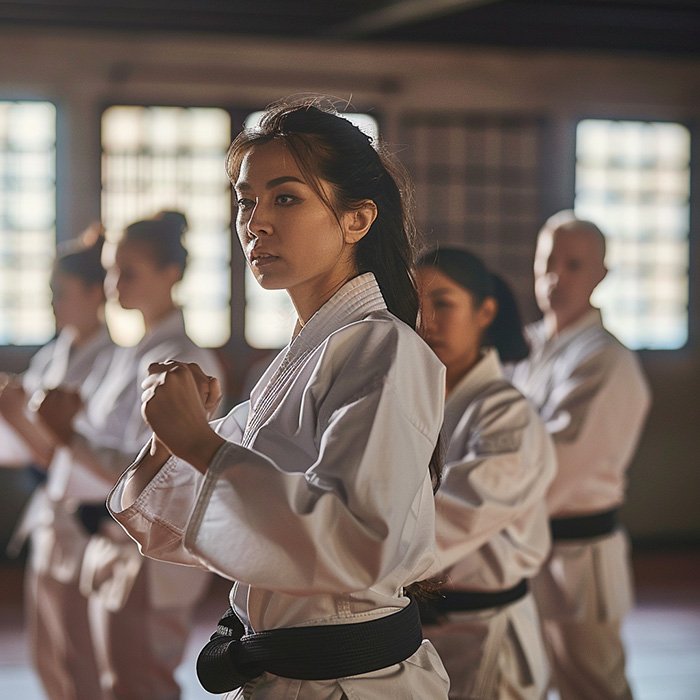
Your mastery of Tang Soo Do begins with disciplined practice of fundamental techniques—the precise execution of punches, kicks, blocks, and stances that form the art’s technical foundation. These core movements aren’t trained in isolation; they’re systematically integrated through one-step sparring drills and partner exercises that develop timing, distance control, and defensive reflexes. Traditional forms (hyung) serve as the bridge between basic techniques and combat application, encoding centuries of martial wisdom into structured sequences that refine your coordination, breathing, and mental focus. Each move in a form has a specific purpose, connecting defensive applications with offensive transitions in a continuous flow of martial technique.
Fundamental Striking and Blocking
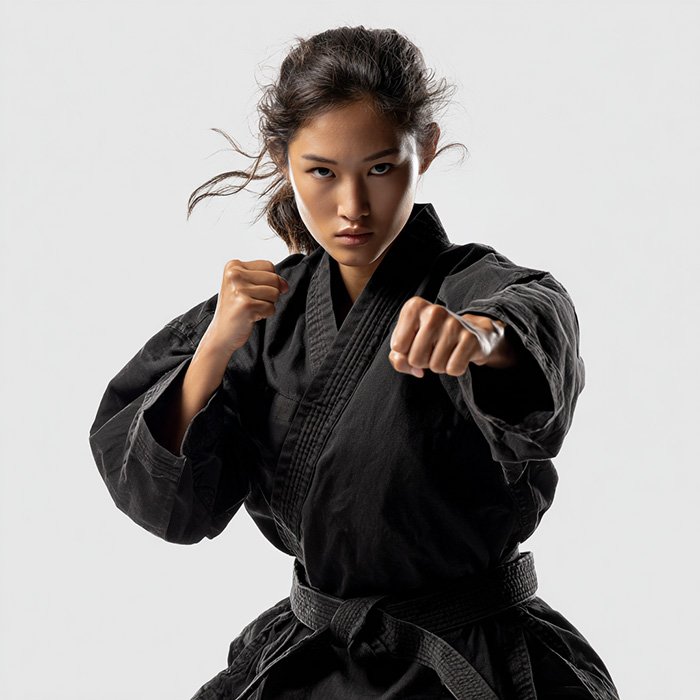
As you begin your journey in Tang Soo Do, mastering fundamental striking and blocking techniques forms the essential foundation upon which all advanced skills are built. Your hand strikes include jab and cross punches for speed, back knuckle strikes for quick attacks, and ridge hand strikes for powerful self-defense applications. You’ll execute knife-hand techniques targeting vulnerable areas like the temple, neck, and collarbone.
Your defensive arsenal comprises four primary blocks: low, high, inside-to-outside, and outside-to-inside. You’ll practice these from horse stance and front stance, ensuring proper coverage—low blocks protect above the knee while high blocks shield your head. Through repetitive drills, you’ll develop muscle memory, transitioning between stances while maintaining guard. Partner drills sharpen your timing and reactive capabilities, progressing gradually from basic execution to sparring applications. The emphasis on speed and precision distinguishes Tang Soo Do from other martial arts styles.
Traditional Forms Training
Traditional forms, known as hyung in Tang Soo Do, represent choreographed sequences of defensive and offensive techniques that encode centuries of combat wisdom into structured practice. You’ll progress through three distinct phases: basic learning of movement patterns, application integration emphasizing breathing control and power management, and refinement focusing on extension, timing, and aesthetic flow.
Your technical execution demands straight-line movement with dynamic hip rotation, characterful stances providing stability, and deliberate footwork patterns called Jin Do. You’ll synchronize breathing with techniques while alternating tension and relaxation strategically to maximize explosive power without fatigue.
Breaking forms into components allows concentrated practice before full integration. Through repetition with conscious attention to rhythm and stance transitions, you’ll develop muscle memory and precision that distinguishes advanced practitioners from novices. Training with awareness and realism helps you control power in the execution of physical techniques against multiple opponents.
Philosophical Principles and Spiritual Foundations
Tang Soo Do builds its foundation upon the integration of physical discipline with spiritual cultivation, recognizing that technical mastery without inner development produces an incomplete martial artist. You’ll cultivate a tranquil yet adaptable mindset rooted in Taoist principles, where opposites transform into each other, and harmony with nature’s laws guides your practice.
Your training centers on Five Codes and Seven Tenets—loyalty, integrity, perseverance, respect, self-control, humility, and indomitable spirit. These aren’t abstract ideals but practical tools shaping your daily conduct. You’ll unify body, mind, and spirit through disciplined practice, channeling Ki to achieve higher states of being.
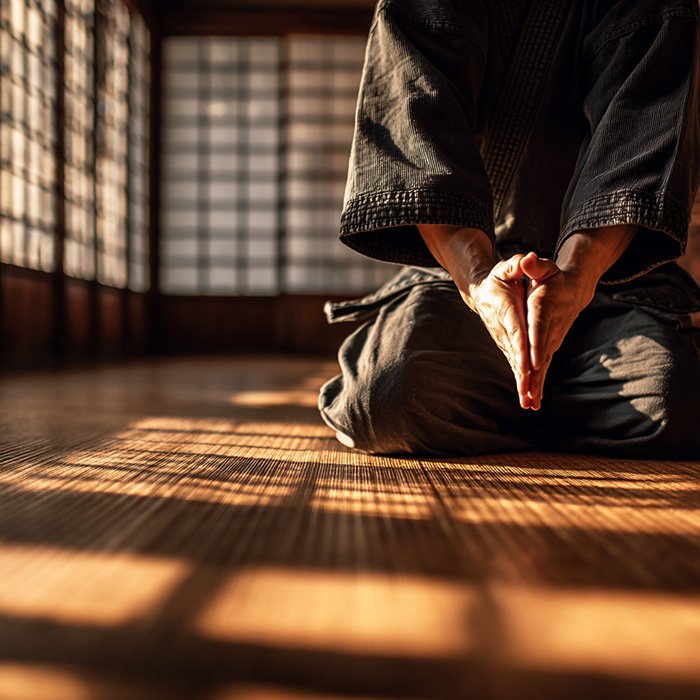
Respect permeates every aspect, demonstrated through bowing and reverence for all life. Respect is not fear or submission, but genuine admiration and recognition of worth in others. This philosophical depth transforms self-defense into a path toward self-mastery, where you confront internal obstacles and develop moral character that extends beyond the dojang.
Tang Soo Do’s Relationship to Taekwondo and Karate
Understanding the lineage of Tang Soo Do requires tracing back to mid-20th-century Korea, where the art emerged from Okinawan Shōtōkan Karate’s technical foundation, enriched by traditional Korean practices like Taekkyeon and Subak, and northern Chinese martial influences. You’ll find Tang Soo Do preserved older karate elements through traditional Japanese kata, while Taekwondo evolved toward sport competition with distinct Taegeuk and Chang-hon forms.
The 1950s unification of Korean Kwan created Taekwondo as a national martial art, absorbing many Tang Soo Do schools. However, independent practitioners maintained Tang Soo Do’s balanced hand-strike and kicking approach, contrasting Taekwondo’s dynamic kick emphasis. Notable Tang Soo Do organizations like the World Tang Soo Do Association and International Tang Soo Do Federation preserved the traditional curriculum while Taekwondo standardized under the Kukkiwon system. You’ll notice Tang Soo Do includes weapons training—particularly staff techniques from Chinese Kung Fu—whereas Taekwondo focuses exclusively on empty-hand combat. Both arts share karate heritage, yet their technical philosophies diverged significantly.
Global Expansion and Modern Organizations
Following Hwang Kee’s formal establishment of the Moo Duk Kwan school in 1945, Tang Soo Do’s international presence emerged through strategic institutional development rather than organic diffusion. Key ambassadors like Grand Master Kang Uk Lee systematically introduced the art to Europe in the early 1970s, while Master Jae Chul Shin established foundations in the United States from 1968 onward.
Organizational fragmentation subsequently defined Tang Soo Do’s global architecture. Master Shin’s departure from Moo Duk Kwan spawned the World Tang Soo Do Association in 1982, exemplifying how independent federations proliferated worldwide. You’ll find Tang Soo Do now operates across thirty-plus countries through multiple governing bodies, maintaining distinct curricula yet preserving traditional values. The art’s foundation synthesizes techniques from Chinese Tang Dynasty warhttps://blog.jamesmartialartsacademy.com/wp-content/uploads/2024/06/woman-traveling-in-france-2023-11-27-05-16-47-utc_Easy-Resize.com_.jpgrs with indigenous Korean martial traditions, including Soo Bahk Ki, Tae Kyon, and Kwon Bup that developed during the Three Kingdoms pehttps://blog.jamesmartialartsacademy.com/wp-content/uploads/2024/06/woman-traveling-in-france-2023-11-27-05-16-47-utc_Easy-Resize.com_.jpgd.
These federations coordinate through world headquarters—Burlington, North Carolina, which houses the WTSDA, supporting over 100,000 practitioners through standardized certification programs and international seminars.
The Hwarang Legacy and Traditional Values in Practice
Beyond Tang Soo Do’s institutional framework lies a philosophical foundation reaching back thirteen centuries to the Hwarang warhttps://blog.jamesmartialartsacademy.com/wp-content/uploads/2024/06/woman-traveling-in-france-2023-11-27-05-16-47-utc_Easy-Resize.com_.jpgrs of the Silla Dynasty, Korea (668–935 AD). These elite aristocratic warhttps://blog.jamesmartialartsacademy.com/wp-content/uploads/2024/06/woman-traveling-in-france-2023-11-27-05-16-47-utc_Easy-Resize.com_.jpgrs pioneered Korean martial arts by integrating combat techniques with Buddhist-influenced ethics emphasizing self-control, loyalty, and courage. They unified the Korean peninsula while establishing a warhttps://blog.jamesmartialartsacademy.com/wp-content/uploads/2024/06/woman-traveling-in-france-2023-11-27-05-16-47-utc_Easy-Resize.com_.jpgr code balancing external skills with internal character cultivation.
You’ll find this legacy preserved in Tang Soo Do’s Five Codes, which originated with monk Won Kwang and mandate respect, duty, and ethical conduct. Founder Hwang Kee revitalized these principles post-WWII, blending Hwarang philosophy with Chinese and Japanese influences. Your training reflects this heritage through the disciplined practice of forms, meditation, and the master-student lineage, maintaining an unbroken connection to ancient warhttps://blog.jamesmartialartsacademy.com/wp-content/uploads/2024/06/woman-traveling-in-france-2023-11-27-05-16-47-utc_Easy-Resize.com_.jpgrs who shaped Korea’s martial identity.
Conclusion
You’ve now explored Tang Soo Do’s deep-rooted traditions, from its ancient Korean origins to Grandmaster Hwang Kee’s systematic codification. You’ve examined its technical foundations, philosophical underpinnings, and historical connections to related martial arts. As you continue your training, you’ll embody the Hwarang warhttps://blog.jamesmartialartsacademy.com/wp-content/uploads/2024/06/woman-traveling-in-france-2023-11-27-05-16-47-utc_Easy-Resize.com_.jpgrs’ virtues while mastering precise techniques. Remember, Tang Soo Do isn’t merely physical discipline—it’s a lifelong journey that requires dedication, respect, and an unwavering commitment to traditional values. Your path demands consistent practice and humble perseverance.