Discipline Training Martial Arts Children
When you enroll your child in martial arts, you’re investing in discipline training that combines physical conditioning with structured mental exercises. You’ll see them develop impulse control, emotional regulation, and focused attention through repetitive technique practice. Respectful rituals and belt progression milestones build confidence and a growth mindset. Your child learns to pause before reacting, make deliberate choices, and build resilience. Understanding how these elements work together reveals the full scope of transformation.
Physical Foundation: Building Strength and Fitness Through Martial Arts
When children engage in martial arts training, they’re simultaneously building the physical foundation that supports both immediate performance and long-term health. You’ll notice rapid improvements in cardiovascular endurance, muscular strength, and explosive power as your child progresses through structured belt levels. The repetitive drills and controlled sparring develop functional strength in realistic movement patterns while enhancing balance and coordination through complex sequences.
Regular practice cultivates overall body strength via weight-bearing stances and resistance-based moves. Progressive skill acquisition motivates consistent effort, ensuring incremental gains in muscular endurance. Enhanced joint stability and muscular balance reduce injury risk during physical activities. Your child builds physical resilience through conditioning drills that improve stress tolerance and recovery capacity, establishing healthy habits that extend far beyond the training mat. Research demonstrates that martial arts interventions produce statistically significant improvements in parameters like cardiorespiratory fitness, speed, agility, strength, flexibility, coordination, and balance across diverse martial arts disciplines.
Mental Discipline: Developing Focus and Cognitive Control
When you engage in martial arts training, you’re building mental discipline through repetitive practice that sharpens your ability to concentrate on precise movements and sequences. This focused repetition strengthens your impulse control by requiring you to pause, assess, and respond thoughtfully rather than react automatically to situations. Through consistent attention to detail in drills and techniques, you develop the cognitive control necessary to manage distractions and maintain composure under pressure. Research indicates that martial arts training specifically improves executive functions, including self-control and inhibition, which are critical for at-risk youths to redirect their behavioral patterns.
Focus Through Repetitive Practice
Martial arts training builds mental discipline through structured, repetitive practice that strengthens your child’s ability to concentrate and sustain attention over time. When your child repeatedly performs punches, kicks, and blocks, they develop muscle memory while cultivating patience through consistent effort.
This repetition transforms mistakes into valuable learning opportunities, fostering resilience and a growth mindset. As your child masters complex movement sequences, they hold multiple steps in working memory, directly boosting cognitive control and focus. Instructors redirect attention when students become distracted, maintaining focused training sessions that reinforce concentration habits.
The dojo’s clear rules and belt progression systems reinforce discipline and create an expectation of sustained attention. Regular physical activity releases endorphins, enhancing mood and cognitive readiness. Through deliberate, repetitive drills, your child’s neural circuits strengthen, improving concentration skills transferable to academics and daily tasks.
Impulse Control and Attention
Beyond the repetitive drills that build foundational focus, your child’s brain undergoes measurable neurological changes that directly strengthen impulse control and attention regulation. Brain imaging reveals increased P3a amplitude, indicating enhanced focal attention when resolving response conflicts. Your child develops executive attention—the ability to selectively concentrate and inhibit distractions—measurable through performance improvements on attention tasks within 11 weeks of structured training.
This neurological enhancement translates to real-world behavioral changes. Your child learns to pause before reacting, managing stress and emotions during high-pressure situations. The precise physical movements required in martial arts foster body awareness, creating conscious deliberation rather than impulsive action. Through consistent practice in a structured environment, children internalize disciplined decision-making processes that extend beyond the dojo into academic and social settings. Combined with goal-setting progression, this environment consistently exercises self-control, reducing aggression while building psychological resilience.
Respect and Respect: Learning to Honor Instructors and Peers
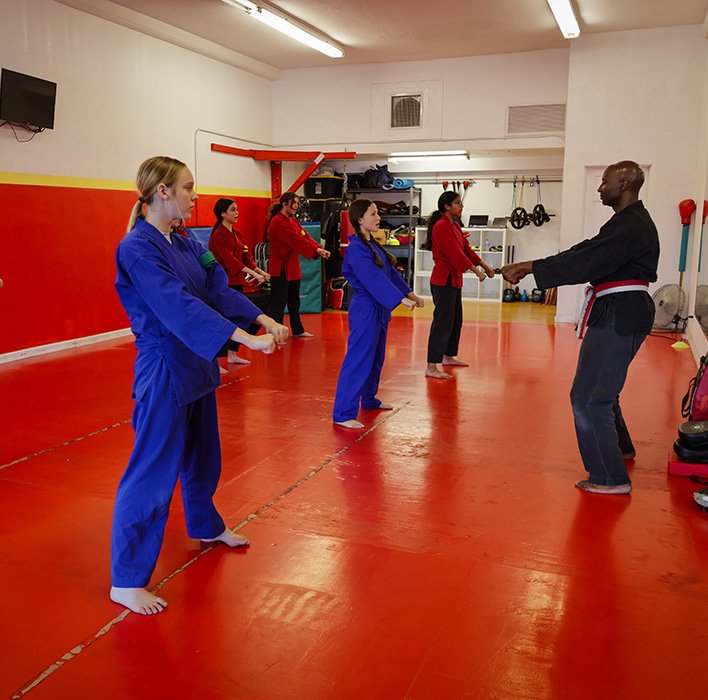
Respect forms the foundation of martial arts training, and it’s built through structured rituals that teach children to honor both their instructors and peers. You’ll notice how bowing and formal greetings establish ritualized acknowledgment of others, while honorific language creates a respectful classroom atmosphere that reinforces positive hierarchy.
Through pair and group drills, your child learns cooperation and empathy, valuing training partners’ efforts while developing social bonding. You’ll see them practice patience by waiting their turn and accepting constructive feedback respectfully. These interactions provide direct exposure to positive role models who demonstrate respectful behavior consistently through their engagement with peers.
Respecting instructors as mentors builds trust and encourages humility, openness to learning, and acceptance of guidance. This respect deepens your child’s appreciation of martial arts as a sehttps://blog.jamesmartialartsacademy.com/wp-content/uploads/2024/06/woman-traveling-in-france-2023-11-27-05-16-47-utc_Easy-Resize.com_.jpgus discipline. Collectively, these practices cultivate emotional regulation, self-confidence, and character traits that transfer beyond the dojo into school and home environments.
Goal-Setting Through Belt Progression: The Path to Achievement
One of the most powerful tools your child’ll encounter in martial arts training is the belt system—a structured framework that transforms abstract skill development into concrete, achievable goals. Each belt represents a clear milestone, motivating your child through visible progression. Early belts establish foundational techniques while intermediate ranks build tactical understanding and adaptability. Advanced belts emphasize refinement and leadership opportunities.
This system teaches delayed gratification and discipline by linking competency directly to recognition. Your child develops confidence through measurable accomplishments, reinforcing goal-setting skills essential beyond the dojo. Promotion ceremonies celebrate progress publicly, strengthening family involvement and community bonds. Rather than viewing the black belt as a final destination, your child learns continuous improvement. The belt structure cultivates a growth mindset, ensuring training remains purposeful and rewarding throughout their martial arts journey. When your child turns 16, they are immediately promoted to the adult ranking system, transitioning from youth belts that include striped variations to the standard white, blue, purple, brown, and black belt progression.
Self-Control and Emotional Regulation in Training
You’ll develop impulse control through the repetitive practice of techniques, which trains your nervous system to pause before reacting emotionally. As you master each movement and advance through belt levels, you’re building emotional resilience by learning to manage frustration, disappointment, and excitement in a safe, structured environment. This foundation of self-regulation strengthens your ability to respond thoughtfully rather than react impulsively when facing challenges both inside and outside the dojo. Over time, this delayed gratification becomes a natural response pattern that extends to your daily life, helping you make deliberate choices instead of following every impulse.
Impulse Control Through Repetition
Martial arts training fundamentally rewires how children respond to stimuli by replacing reactive impulses with deliberate, controlled actions. Through repetitive practice of kicks, punches, and stances, you’ll notice your child develops stronger body awareness and intentionality in movement. This physical control extends beyond the dojo—your child learns to regulate strength and motion across daily activities.
Repetition embeds impulse control as a neural habit. Each drill reinforces the pause between stimulus and response, the critical gap where self-discipline operates. Breathing exercises and focus techniques practiced during classes become accessible tools your child deploys when facing frustration or pressure. Martial arts disciplines like Karate and Taekwondo emphasize mental focus and self-control through structured kata and form repetition, which directly strengthens these regulatory capacities. As muscle memory strengthens, so does your child’s capacity to choose thoughtful reactions over instinctive ones, establishing self-regulation patterns that persist in real-world challenges.
Emotional Balance and Resilience
As your child progresses through martial arts training, they’ll develop sophisticated emotional regulation skills that transform how they process and respond to feelings. The structured environment cultivates self-control by demanding disciplined responses to challenges, strengthening impulse control and delayed gratification. Your child learns to manage aggressive tendencies through controlled emotional expression, building psychological resilience that extends beyond the dojo.
Repeated practice reinforces executive functions—attention control, planning, and decision-making—essential for emotional balance. When your child encounters obstacles during training, they develop grit and adaptive coping strategies that transfer to everyday stressors. This deliberate engagement with difficulty creates psychological resources protecting against emotional exhaustion. The combination of discipline and perseverance establishes lasting mental toughness, enabling your child to bounce back from setbacks with newfound confidence and emotional stability. Research demonstrates that taekwondo training significantly enhances emotional regulation and stress management capabilities in children.
Perseverance Under Physical and Mental Challenge
Three critical components—mental resilience, physical challenge, and emotional support—work together to build perseverance in children through martial arts training.
You’ll develop mental resilience as you push through demanding techniques and sparring sessions, learning to view setbacks as growth opportunities rather than failures. This reframing builds patience and frustration management skills that extend beyond the mat.
Physical challenges strengthen your perseverance through incremental goal-setting like belt promotions. Repetitive training under controlled stress conditions enhances your focus and discipline while building genuine endurance. Research by Dr. Angela Duckworth demonstrates that grit predicts long-term success more reliably than innate talent or intelligence, making martial arts training an investment in your child’s future achievements.
Equally important, you’ll gain emotional regulation skills during adversity. Your instructors and peers create a supportive community where you safely encounter challenges, manage fear, and celebrate progress. This foundation equips you to persist through academic, social, and personal obstacles throughout your life.
Behavioral Transformation: From Training to Daily Life
The resilience you’ve built through demanding training doesn’t stay confined to the dojo—it actively shapes how you navigate daily challenges, interact with peers, and approach academic responsibilities. You’ve internalized discipline through belt progression and incremental goal-setting, translating that accountability framework into classroom performance and interpersonal relationships. The self-control you’ve developed redirects impulses productively, enabling you to respond thoughtfully rather than reactively to frustration. Your experience overcoming physical and mental obstacles builds confidence that extends to academic pursuits and social situations. This behavioral transformation reflects genuine character development: you’re not simply following rules, you’re embodying the principles that martial arts instill. The habits you’ve cultivated—persistence, respect, emotional regulation—become foundational to your identity beyond training.
Building Confidence and Resilience Through Skill Mastery
One of martial arts’ most transformative gifts is the direct link it forges between effort and measurable achievement. When you advance through belt ranks or master new techniques, you’re building concrete proof of your progress. This tangible success cultivates genuine confidence grounded in real competence, not empty praise.
You’ll develop resilience by repeatedly practicing movements until they click, learning that persistence pays off. During sparring and challenging drills, you’ll practice emotional control, staying composed under pressure. This mindfulness reduces stress and strengthens your ability to handle frustration constructively.
The demanding nature of training teaches you determination and grit—qualities that transfer directly to academics and personal challenges. You’re not just earning belts; you’re building a foundation of self-belief that extends far beyond the dojo.
Safety Practices: Responsible Training for Injury Prevention
While building confidence through skill mastery creates a strong foundation, you’ll also need to understand how responsible training practices protect your child’s physical well-being. You should phttps://blog.jamesmartialartsacademy.com/wp-content/uploads/2024/06/woman-traveling-in-france-2023-11-27-05-16-47-utc_Easy-Resize.com_.jpgritize proper technique and blocking skills, which significantly reduce concussion risk. Ensure your child’s instructor enforces strict safety rules consistently and progresses gradually from non-contact to contact training only after demonstrating adequate maturity and fundamental mastery.
You’ll want to know that injury rates peak around age twelve, particularly with high-contact disciplines like MMA and competition sparring. Limiting training to three hours weekly and selecting age-appropriate disciplines prevents overuse injuries. Work with your child’s coach to implement phased training approaches and obtain safety education. Remember that protective equipment alone doesn’t prevent sehttps://blog.jamesmartialartsacademy.com/wp-content/uploads/2024/06/woman-traveling-in-france-2023-11-27-05-16-47-utc_Easy-Resize.com_.jpgus injuries—responsible supervision and developmentally appropriate progression are essential safeguards.
Conclusion
You’ll discover that martial arts training transforms your child into a disciplined, confident individual. Through consistent practice, you’re building their physical strength, mental resilience, and emotional control. You’re teaching them respect, goal-setting, and perseverance that extend far beyond the dojo. When you phttps://blog.jamesmartialartsacademy.com/wp-content/uploads/2024/06/woman-traveling-in-france-2023-11-27-05-16-47-utc_Easy-Resize.com_.jpgritize safety and proper technique, you’re creating a foundation for lifelong healthy habits and genuine self-confidence that’ll serve them throughout their lives.