Martial Arts Techniques: Joint Locks
Joint locks are controlled techniques that apply force against a joint’s natural range of motion to create submission through leverage rather than strength. You’ll target specific areas like wrists, elbows, shoulders, knees, and ankles by using proper body mechanics and positioning. These manipulations exploit structural vulnerabilities in hinge and ball-and-socket joints through hyperextension, rotation, or compression. When you execute them correctly, you’ll maximize mechanical advantage while minimizing injury risk. Understanding the biomechanical principles and safe training protocols will help you master these foundational grappling skills.
Understanding the Biomechanics of Joint Manipulation
When executing joint locks effectively, practitioners must first grasp how joints function as biomechanical lever systems with specific axes of rotation and finite ranges of motion. You’ll maximize control by applying force perpendicular to the joint’s natural plane of motion, exploiting structural vulnerabilities in ligaments and joint capsules. Understanding each joint’s degrees of freedom enables precise targeting with minimal effort.
Your force application must respect kinematic limits to prevent injury while achieving submission. Proper body alignment and weight distribution amplify mechanical advantage, allowing small forces to generate significant joint torque. You’ll need coordinated muscle activation patterns to transfer kinetic energy efficiently through distal segments acting as fulcrums. Prophttps://blog.jamesmartialartsacademy.com/wp-content/uploads/2024/06/woman-traveling-in-france-2023-11-27-05-16-47-utc_Easy-Resize.com_.jpgceptive feedback guides optimal joint angles during execution, ensuring you maintain control while avoiding hyperextension beyond safe thresholds. Leveraging the opponent’s body weight and positioning creates an additional mechanical advantage that reduces the effort required to maintain the lock.
Primary Categories of Joint Locks by Target Area
When you study joint locks systematically, you’ll find they naturally organize into three anatomical zones: upper body targets (shoulders, elbows, wrists, and fingers), lower limb controls (hips, knees, ankles, and toes), and spinal manipulations (cervical, thoracic, and lumbar regions). Each category exploits specific biomechanical vulnerabilities—upper body locks leverage the limited range of motion in hinge joints, lower limb techniques capitalize on weight-bearing joint instability, and spinal locks apply controlled force to vertebral articulations. The effectiveness of these techniques relies on proper alignment and leverage rather than raw strength, allowing practitioners to control opponents through biomechanical advantage. Understanding these distinctions allows you to select appropriate techniques based on positional control, opponent size, and acceptable risk parameters.
Upper Body Joint Targets
Upper body joint locks form the foundation of standing and ground-based control systems across most grappling martial arts. You’ll find four primary target areas: wrists, elbows, shoulders, and fingers, each offering distinct tactical advantages.
Wrist locks apply rotational or hyperextension forces for pain compliance and control. You can execute them safely in competition due to joint flexibility. Elbow locks utilize hyperextension (straight armlocks) or rotational pressure (bent armlocks) like the Americana and Kimura, commonly applied from mount or side control positions.
Shoulder manipulations leverage the joint beyond natural limits, targeting the rotator cuff and capsule. They’re effective for both submission and control scenahttps://blog.jamesmartialartsacademy.com/wp-content/uploads/2024/06/woman-traveling-in-france-2023-11-27-05-16-47-utc_Easy-Resize.com_.jpgs. Finger locks isolate individual digits for compliance but carry high injury risk, leading to competitive restrictions. Neck cranks and spinal locks extend the upper body targeting system to include cervical and vertebral manipulation. You’ll need precise technique and safety awareness when applying any upper-body joint manipulation.
Lower Limb Control Techniques
Lower body joint locks target the ankle, knee, hip, and foot structures to control, submit, or destabilize your opponent through mechanical advantage. Ankle locks exploit limited rotational capacity through straight ankle locks and heel hooks, with the latter creating dangerous knee torque requiring strict regulation. You’ll apply kneebars by hyperextending the knee beyond its natural range, utilizing a fulcrum while maintaining proper body alignment. Toe and foot locks manipulate smaller joints, serving as distraction setups or quick submissions that exploit neurological pain responses. Hip locks demand precise positioning to generate rotational forces against the joint’s naturally strong structure. All lower limb techniques require securing control points, breaking balance (kuzushi), and exercising caution due to significant injury potential, particularly with heel hooks. These techniques have generated fascination and controversy within the Brazilian Jiu-Jitsu community regarding their usage and regulation.
Spinal and Neck Locks
While lower limb techniques control your opponent through peripheral joint manipulation, spinal and neck locks attack the body’s central structural column—the most vulnerable and consequential target area in submission grappling. Neck cranks force cervical hyperflexion, typically from mounted or side-mount positions, creating extreme stress on cervical vertebrae. You’ll encounter variations including crucifix neck cranks, mandible locks, and cheekbone controls that exploit facial anatomy for submission. Face locks apply pressure to the orbital bones, temple, or nose bridge during guard passes. The “Twister” delivers lateral torsion to the upper spine but remains banned in most competitions. Spine locks require significant leverage from rear mount positions due to torso strength. The execution often involves interlocking arms behind the opponent’s back to secure the position before applying pressure. These techniques carry catastrophic injury potential, demanding advanced technical proficiency and strict safety protocols during training.
Arm and Shoulder Lock Variations
Arm and shoulder locks form a fundamental category of joint manipulation techniques that target the complex biomechanics of the upper limb’s articulation points. You’ll encounter several primary variations: the Kimura employs a double wrist grip to apply rotational pressure, while the Americana forces external rotation at a right angle. The straight armbar hyperextends the elbow using your hips as a fulcrum. Figure-four configurations maximize control through secure gripping patterns.
Effective application requires you to maintain secure wrist and elbow control while positioning your body to optimize leverage. You must apply pressure gradually, preventing injury while encouraging submission. Your success depends on whole-body coordination—integrate hip movement with arm positioning. When facing defensive movements, you should adjust the body angle to follow the opponent’s movement and restore leverage. Standing variations demand speed and precise timing. Brazilian Jiu-Jitsu, Aikido, and classical Ju-Jutsu systems emphasize these techniques differently, adapting principles to their tactical frameworks.
Lower Body Joint Lock Applications
Lower body joint locks target the knee, ankle, and hip joints through controlled leverage and rotational pressure. You’ll apply knee locks by hyperextending the joint while securing the leg, whereas ankle locks manipulate foot positioning to generate torque. Hip locks require precise body mechanics to create rotational force on the pelvis, demanding careful execution to prevent sehttps://blog.jamesmartialartsacademy.com/wp-content/uploads/2024/06/woman-traveling-in-france-2023-11-27-05-16-47-utc_Easy-Resize.com_.jpgus ligament damage. These techniques are part of vahttps://blog.jamesmartialartsacademy.com/wp-content/uploads/2024/06/woman-traveling-in-france-2023-11-27-05-16-47-utc_Easy-Resize.com_.jpgus martial arts, including Shoot Wrestling, Catch Wrestling, Judo, Sambo, and Brazilian Jiu-Jitsu.
Knee Lock Mechanics
Because the knee joint operates primarily as a hinge mechanism with limited rotational capacity, it becomes exceptionally vulnerable when martial artists apply torque or hyperextension beyond its anatomical range. You’ll compromise the ACL, PCL, MCL, and LCL through controlled manipulation of proximal and distal control points—specifically the thigh and shin.
Knee bars work by trapping your opponent’s leg between your thighs while arching backward, creating hyperextension. Knee cranks add rotational stress through twisting motions. Standing variations like knee kao involve hooking the heel and shifting your weight forward to force joint compromise.
You must control both isolation points simultaneously to generate sufficient leverage. The knee’s limited rotational stability makes twisting locks particularly effective yet dangerous, demanding precise technical execution in supervised training environments to prevent ligament tears and permanent instability. Joint locks and submission techniques naturally complement striking methods by providing control options that dictate the tempo of an engagement.
Ankle and Hip Locks
Joint locks targeting the ankle and hip extend your submission arsenal beyond upper body controls, exploiting biomechanical vulnerabilities in weight-bearing structures that evolved for stability rather than multidirectional resistance.
The straight ankle lock applies direct Achilles tendon pressure through foot isolation and spinal arching, while Ashi Garami positions—with one leg inside, one outside—provide essential control leverage. You’ll maximize effectiveness by rotating the foot sideways rather than pulling backward, positioning your hips beneath the ankle joint as a fulcrum. The heel hook delivers devastating twisting force but carries significant injury risk, making it competition-banned in many formats.
Effective execution demands precise angle application, maintained connection, and readjusted positioning against defensive counters. The 50/50 guard offers modern offensive opportunities, though controlled technique and immediate tap-out recognition remain paramount for injury prevention. Maintaining constant pressure on the opponent’s leg through strategic use of hips and legs diminishes their ability to escape or counter.
Pain Compliance and Neurological Response Mechanisms
Pain compliance operates through deliberate activation of nociceptors—specialized sensory receptors that detect potentially harmful stimuli—to trigger reflexive motor responses and cognitive decision-making favoring submission. You’re manipulating pain signals that travel through sensory nerves to the brain, temporarily overriding your opponent’s willingness to resist. However, you must understand the critical threshold: excessive pain triggers an amygdala hijack—a neurological survival response where cognitive control disappears and pain defiance replaces compliance.
Your technique’s effectiveness depends heavily on your opponent’s psychological state, pain tolerance, and motivation. Intoxicated or highly resistant individuals often exhibit delayed pain signal processing, making compliance unreliable. You’ll achieve optimal results through precise leverage and controlled application, creating pattern interrupts that change behavior without escalating to structural damage. Most effective systems employ hybrid techniques that progressively increase both pain and structural damage as the situation demands. Never overrely on pain compliance alone—prepare alternative control methods when neurological variability renders pain-based techniques ineffective.
Traditional Martial Arts Systems and Joint Lock Philosophies
Chinese Qin Na emphasizes “seizing and controlling” through anatomical leverage and pressure point manipulation, phttps://blog.jamesmartialartsacademy.com/wp-content/uploads/2024/06/woman-traveling-in-france-2023-11-27-05-16-47-utc_Easy-Resize.com_.jpgritizing sensitivity over brute strength. You’ll develop precision by studying joint locks (chin na), cavity pressing (qin), and tendon seizing (jin).
Korean Hapkido’s Kwan Jul Ki Sul redirects force through circular motion, manipulating wrists, elbows, and shoulders while maintaining your balance. You’ll learn to flow with opponents rather than opposing them directly.
Japanese systems integrate joint locks differently—Karate’s torite appears in kata bunkai applications, while Jujutsu emphasizes “maximum efficiency, minimum harm.” You’ll execute techniques targeting anatomical weaknesses through disciplined, respectful application focused on defense rather than aggression.
Integration With Takedowns and Positional Control
How do you transform a simple joint lock into a decisive takedown? You’ll need to master grip control positions that isolate limbs while disrupting your opponent’s base. Focus on lifting or off-centering joints—particularly the elbow or wrist—to collapse structural integrity and create kuzushi.
Your joint lock functions as both a transitional tool and a control mechanism. Maintain dominant grips above and below the target joint, using mechanical leverage along the path of least resistance. This triggers neurological responses—pain and involuntary muscle tension—that facilitate control without immediate structural damage.
Once you’ve executed the takedown, seamlessly transition the lock into ground control by adapting angles and applying bodyweight. Pressure distribution and proper alignment maximize leverage while minimizing counter opportunities, enabling efficient energy use against stronger opponents.
Safe Training Practices and Injury Prevention
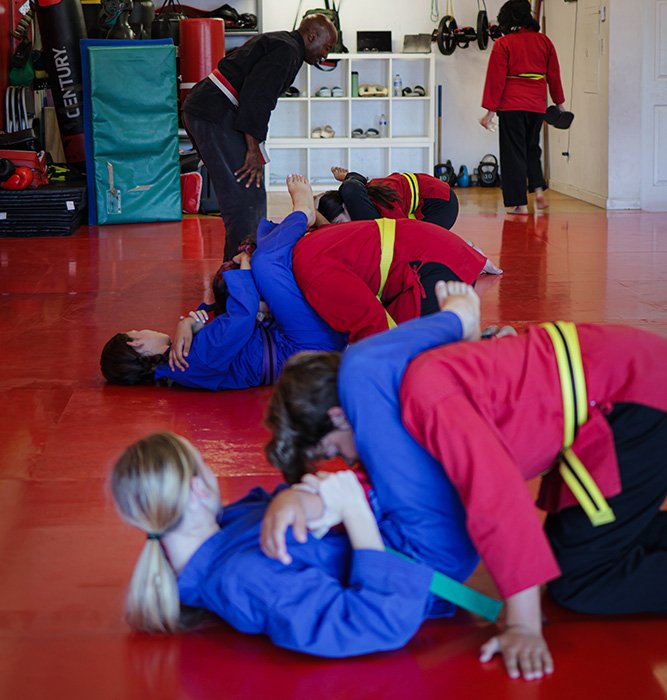
Mastering joint locks demands rigorous attention to training protocols that protect both you and your partner from preventable injuries. Apply locks gradually—never snap into position. Establish clear feedback systems: tap signals or verbal cues like “break” must trigger immediate release. Your partner should remain passive during execution to minimize joint stress.
Before training, perform joint mobility exercises and warm-ups to prepare tissues. Progress systematically from low-resistance drills to advanced techniques, focusing on mechanical leverage rather than brute force. Maintain proper body alignment to prevent hyperextension.
Recognize that adrenaline alters pain perception under stress, making controlled training essential. Learn anatomical limitations—some joints withstand more pressure than others. Professional supervision in controlled environments ensures technique refinement while minimizing trauma risk. Train both the application and safe release protocols consistently.
Conclusion
You’ve now explored the fundamental principles governing effective joint manipulation. Remember, you’ll only develop a reliable technique through consistent, controlled practice with attentive partners. Don’t rush progressions—you’re working with vulnerable anatomical structures that demand respect. Always communicate clearly during training, tap early, and release immediately when your partner signals. Your technical proficiency means nothing if you’re injuring training partners. Phttps://blog.jamesmartialartsacademy.com/wp-content/uploads/2024/06/woman-traveling-in-france-2023-11-27-05-16-47-utc_Easy-Resize.com_.jpgritize safety, study biomechanics continuously, and you’ll build a sustainable joint lock practice that’ll serve you for years.