Karate Santee
You’ll find karate fights in Santee through local dojos offering point-sparring tournaments and full-contact competitions that emphasize punching combinations, counter-attacks, and distance management. Modern karate competition rewards rapid striking sequences with 1-2 points for hand techniques, while stricter safety enforcement has reduced injury rates significantly since the late 1990s. Success hinges on attack frequency patterns and counter-fighting ability—statistical models predict winners with 94% accuracy based on these metrics. The following sections break down exactly how technique selection, rule structures, and training methodologies determine competitive outcomes.
The Dominant Role of Punches in Modern Karate Competition
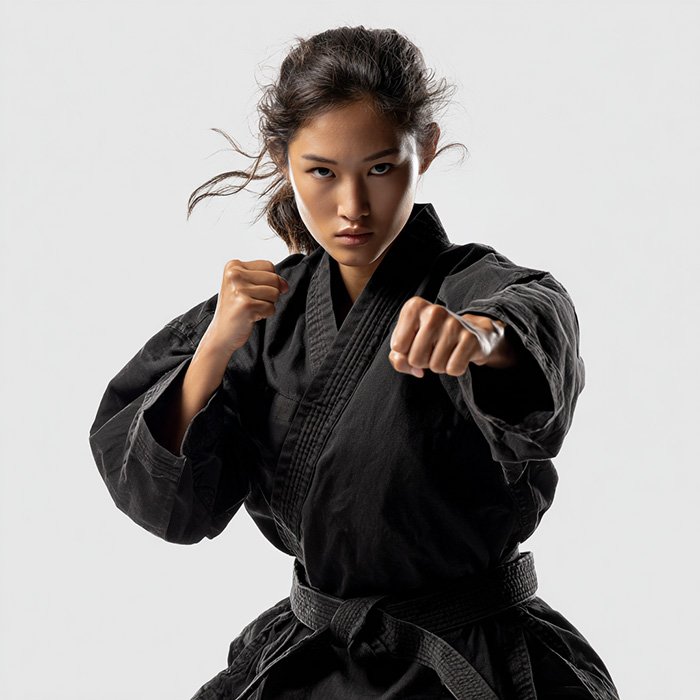
Although kicks receive higher point values in modern karate competition, punches dominate the tactical landscape through their supehttps://blog.jamesmartialartsacademy.com/wp-content/uploads/2024/06/woman-traveling-in-france-2023-11-27-05-16-47-utc_Easy-Resize.com_.jpgr speed and minimal telegraph time. You’ll find punches strategically crucial in close-range combat where kicks become impractical. Their direct linear path allows you to exploit openings during exchanges, typically scoring 1 point with precision and timing rather than raw force.
You can effectively use punches as opening techniques to create reactions, forcing opponents into defensive positions that expose vulnerabilities for higher-scoring attacks. In confined competition spaces, rapid punching sequences apply psychological pressure while maintaining tempo control. Counter-punching serves as both a deterrent and a tactical advantage, particularly when cornering opponents. Biomechanical differences in punching exist across martial arts styles, influencing the effectiveness of vahttps://blog.jamesmartialartsacademy.com/wp-content/uploads/2024/06/woman-traveling-in-france-2023-11-27-05-16-47-utc_Easy-Resize.com_.jpgus striking approaches. Head and body targeting optimizes your scoring opportunities, emphasizing clean contact and technical control over brute impact force in face-to-face matchups.
How Rule Changes Impact Injury Rates and Technique Selection
The World Karate Federation’s 2000 rule changes fundamentally reshaped injury patterns and technique deployment in competitive karate. You’ll observe head injuries dropping from 8.05 to 4.1 per 100 exposure minutes between 1997 and 2002, while leg injuries increased dramatically from 0.54 to 3.33. This redistribution directly correlates with updated scoring systems awarding 2-3 points for leg techniques versus 1-2 points for hand strikes. You’re incentivized to deploy more kicks, accepting elevated leg injury risk for higher point potential. Stricter enforcement against excessive head contact reduced overall injury incidence from 0.23 to 0.16 per fight. Younger competitors, particularly females under 18, benefited most from enhanced safety protocols. Female competitors under 18 showed a 2.08 times higher injury risk in 1997 compared to 2002, representing the most dramatic improvement among all demographic groups. You’ll find mild injuries (grade 1) still constitute over 98% of incidents, confirming competitive karate maintains relatively low severity rates despite technique evolution.
Statistical Predictors of Victory: What Separates Winners From Losers
When you analyze karate match outcomes through quantitative models, punches and counter-attacks emerge as near-perfect predictors of victory in Shotokan competition. Logistic regression models demonstrate 94% accuracy using the composite statistic D, which quantifies attack patterns and frequencies. This methodology provides an objective assessment of winning probability by tracking specific techniques rather than subjective evaluations.
Physical attributes further refine predictions. Weight correlates positively with KO/TKO outcomes in male fighters, while fighting style predicts victory modes across both genders. Notably, losses by decision negatively predict winning records, whereas technical falls and knockouts correlate with dominant performance. Male athletes secured victory primarily through KO/TKO methods, while female competitors relied more heavily on winning by decision.
Interestingly, relative age effects disappear at elite levels. Olympic karate athletes show no significant birthdate advantage, confirming that technical proficiency, tactical execution, and psychological factors ultimately separate winners from losers at championship competition.
Karate’s Place in the Mixed Martial Arts Landscape
Since Brazilian Jiu-Jitsu dominated early UFC events through Royce Gracie’s systematic dismantling of strikers, karate’s influence in MMA remained subdued until practitioners integrated comprehensive grappling defense into their arsenals. You’ll find karate’s technical contributions center on precision striking, distance management, and unorthodox angles that create offensive opportunities. Lyoto Machida exemplified this evolution, securing the UFC Light Heavyweight Championship through Shotokan principles merged with submission defense. Modern implementations see fighters like Yair Rodriguez deploying dynamic karate techniques for highlight-reel finishes. The discipline now functions as a specialized striking system within cross-trained frameworks rather than a standalone approach. You’re witnessing karate’s resurgence as fighters recognize its value for counter-striking, footwork mechanics, and exploiting timing windows during stand-up exchanges. While karate maintains its deep cultural roots and structured teaching methods, MMA practitioners extract its most practical elements for competitive application.
Real-World Effectiveness: From the Dojo to Street Defense
Beyond competitive arenas and regulated combat, karate’s defensive utility confronts immediate scrutiny when practitioners face chaotic street encounters without weight classes, referees, or predetermined rules. Your striking arsenal—punches, kicks, elbows, knees—delivers rapid incapacitation potential when executed with proper body mechanics and targeting precision. However, karate’s traditional distance-fighting methodology reveals critical vulnerabilities in close-quarters grappling scenahttps://blog.jamesmartialartsacademy.com/wp-content/uploads/2024/06/woman-traveling-in-france-2023-11-27-05-16-47-utc_Easy-Resize.com_.jpgs where assailants employ clinching or ground tactics. Your effectiveness hinges on maintaining spatial control and preventing range closure. Supplementing karate with grappling disciplines addresses these deficiencies substantially. Mental conditioning proves equally vital; your trained reflexes, situational awareness, and stress inoculation determine whether techniques transition from controlled dojo repetitions to functional defensive responses. The discipline and focus cultivated through karate training extend beyond physical confrontations, enhancing decision-making capabilities in high-pressure situations. Realistic scenahttps://blog.jamesmartialartsacademy.com/wp-content/uploads/2024/06/woman-traveling-in-france-2023-11-27-05-16-47-utc_Easy-Resize.com_.jpg-based training—not kata alone—bridges the gap between traditional practice and unpredictable street confrontations requiring immediate tactical adaptation.
Conclusion
You’ve examined karate’s competitive dynamics, from punch-dominated scoring patterns to statistical victory markers. You’ve analyzed how rule modifications shape technique selection and injury profiles, while considering karate’s contributions to MMA’s striking arsenal. Your understanding now encompasses both sport application and self-defense utility. You’ll recognize that modern karate’s effectiveness stems from its adaptive nature—integrating traditional fundamentals with evidence-based training methodologies. Your analysis confirms that karate’s relevance extends beyond tournament settings into practical combat scenahttps://blog.jamesmartialartsacademy.com/wp-content/uploads/2024/06/woman-traveling-in-france-2023-11-27-05-16-47-utc_Easy-Resize.com_.jpgs.