Kajukenbo Martial Arts in Hawaii
You’ll discover Kajukenbo emerged from Palama Settlement, Honolulu, between 1947 and 1949, when five masters—Adriano Emperado, Joseph Holck, Peter Choo, Frank Ordonez, and Clarence Chang—formed the Black Belt Society to create America’s first hybrid martial art. They synthesized Kenpo, Escrima, Judo, Tang Soo Do, and Jujitsu through brutal street-testing protocols in which broken bones were standard. This fusion prioritized combat effectiveness over tradition, enabling practitioners to fight across all ranges. The system’s evolution from Hawaii’s concrete streets to global recognition reveals how necessity forged innovation.
The Birth of a War System in Palama Settlement
Between 1947 and 1949, five martial artists convened in Palama Settlement—a neighborhood in Honolulu, Oahu, notorious for street violence, fist-fights, and stabbings—to forge what would become Kajukenbo, a hybrid combat system born from necessity rather than tradition. You’ll find that Adriano D. Emperado, Joseph Holck, Peter Y.Y. Choo, Frank F. Ordonez, and Clarence Chang formed the “Black Belt Society,” each contributing specialized expertise: Kenpo, Escrima, Judo, Tang Soo Do, Jujitsu, Boxing, and Kung Fu. They implemented a rigorous testing protocol—techniques proving effective in real combat survived; ineffective methods were eliminated. This environment demanded practicality over ceremony. Training intensity frequently resulted in broken bones and fainting, reflecting their philosophy that survival required uncompromising realism. The harsh street conditions of Palama Settlement functioned as Kajukenbo’s proving ground, shaping its reputation as an exceptionally effective self-defense system. By 1950, the founders transitioned from private training to public instruction under the Kajukenbo Self-defense Institute, marking the formal establishment of their revolutionary martial arts system.
Five Masters Unite: The Black Belt Society
In 1947, five martial artists—Adriano D. Emperado, Joe Emperado, Peter Young Yil Choo, Frank F. Ordonez, and George “Clarence” Chang—united at Honolulu’s Palama Settlement to forge the Black Belt Society. You’ll recognize this alliance as historically significant: it represented one of America’s first deliberate efforts to synthesize multiple Asian martial disciplines into a cohesive fighting system. Each master contributed their most effective techniques from Kenpo, Judo, Karate, Jujitsu, and Chinese boxing, creating what would become Kajukenbo. This pragmatic approach prioritized real-world applicability over ceremonial tradition. The collaboration lasted approximately two years, until the outbreak of the Korean War in 1949 led to its disbandment. Despite this fragmentation, Sijo Adriano Emperado established the first official Kajukenbo school, ensuring the society’s revolutionary methodology survived and proliferated throughout Hawaii and eventually the mainland United States. Training under Emperado was rigorous and demanding, as he refused to admit children to the school and maintained high standards for his students.
Fusion of Fighting Styles: From Kenpo to Escrima
The Black Belt Society’s innovative fusion methodology centers on Kenpo as the structural foundation, systematically integrating Escrima’s weapons-based principles and close-range tactics. You’ll find that this strategic combination wasn’t arbitrary—each founder contributed specific technical elements from their respective disciplines (Judo, Tang Soo Do, Kung Fu, Boxing) based on proven effectiveness in actual confrontations within Palama Settlement’s dangerous environment. The integration process followed a ruthless pragmatism: techniques that succeeded in real street encounters remained in the system, while those failing under pressure were immediately discarded. This collaborative approach enabled practitioners to fight effectively across various ranges and speeds, compensating for the inherent limitations of single traditional martial arts systems.
Core Styles Combined
When five martial artists gathered in the Palama Settlement of Honolulu during the late 1940s, they forged a revolutionary hybrid system that would fundamentally alter the landscape of American martial arts. You’ll find that Kajukenbo’s architects—Adriano Emperado, Joe Holck, Peter Choo, Frank Ordonez, and Clarence Chang—each contributed specialized expertise spanning Kenpo, Karate, Judo, Jujitsu, Boxing, Escrima, and Kung Fu. They established Kenpo as the structural foundation, integrating striking methods, stances, and kata forms to provide organizational coherence. Around this core, they grafted Boxing’s efficient footwork and rapid combinations, Judo’s throwing mechanics, Jujitsu’s joint manipulation, Escrima’s weapon proficiency, and Kung Fu’s dynamic movement patterns. Their selection criteria emphasized pragmatic street effectiveness: techniques that proved viable under realistic conditions remained, while ineffective methods were eliminated. This rigorous, evidence-based approach created comprehensive combat coverage across all ranges and scenarios. These founding experts formed the Black Belt Society, uniting their diverse martial arts backgrounds into a singular vision for realistic self-defense.
Strategic Integration Methods
Strategic integration methods distinguish Kajukenbo from simple technique aggregation by employing systematic frameworks that preserve each component art’s essential characteristics while creating functional synergies. You’ll find Escrima stick training enhances Kenpo’s fluidity through rapid transitional movements, while maintaining distinct striking patterns from each discipline. Instructors implement structured curriculum development that introduces basic Escrima drills alongside Kenpo fundamentals, progressing through isolated techniques, paired drills, and controlled sparring for validation. This approach differs from fusion seminars, emphasizing functional adaptation over pure style preservation. Your training incorporates Boxing, Kickboxing, and Judo elements strategically, not randomly—combining stand-up striking with rapid hand techniques for multiple ranges while integrating ground-fighting elements for close-quarters. Weapon-to-empty-hand transitions develop through deliberate practice, linking stick rhythms with hand strikes to build muscle memory that supports tactical adaptability across armed and unarmed confrontations. The systematic curriculum emphasizes building fundamental skills such as strikes, blocks, and footwork before advancing to more complex combinations and applications.
Street-Tested Training Methods That Built Legends
You’ll find that Hawaii’s martial arts pioneers didn’t coddle their students—training sessions routinely produced injuries that would horrify modern insurance providers, yet these brutal methods forged practitioners capable of surviving actual street violence. The original Kajukenbo students under Emperado endured conditioning so severe that broken bones and lacerations were considered standard tuition rather than training accidents. This calculated brutality served a precise purpose: eliminating the gap between dojo theory and the unforgiving physics of concrete, fists, and desperate opponents who fought without referee intervention. Like the vale tudo phenomenon that emerged in Brazil, these Hawaiian training grounds operated without the sanitized restrictions that would later define commercial martial arts, prioritizing raw effectiveness over participant comfort.
Brutal Realism in Training
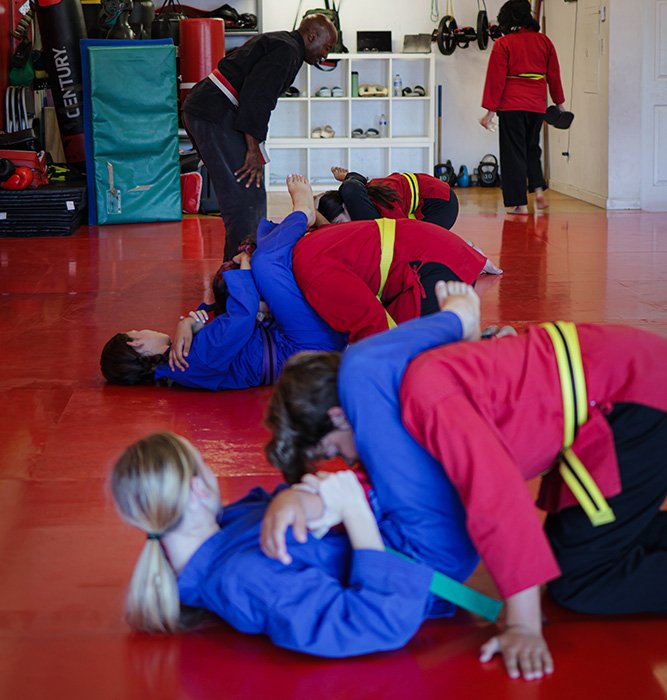
Traditional martial arts training in Hawaii diverged sharply from the choreographed forms and point-scoring systems that dominated mainland dojos, instead forging practitioners through methods that mirrored the visceral reality of street confrontations. You’d experience full-contact sparring incorporating techniques banned in competitive circuits—headbutts, groin strikes, and clothing manipulation—simulating authentic combat scenes. Conditioning emphasized survival against multiple or physically super attackers through high-intensity drills combining brutal strikes: throat attacks targeting the windpipe, eye gouges inducing disorientation, and pressure point manipulation from Dim Mak principles. Training integrated weapon-based striking from Filipino Kali with empty-hand grappling, ensuring fluid transitions between armed and unarmed engagement. Joint manipulations focused on disabling limbs through deliberate breaks rather than submissions, while psychological fortitude development prepared you for unpredictable violence absent rulebooks or referees.
From Injuries to Invincibility
Hawaii’s combat laboratories operated on a philosophy where accumulated trauma became the curriculum itself—each injury documented not as failure but as empirical data refining technique. You’d endure progressive shin conditioning and controlled pain exposure, transforming vulnerable anatomical structures into weapons. The Black Belt Society’s “old school” methodology systematically analyzed street encounters from 1947 to 1949, identifying which techniques failed under duress and which incapacitated aggressors effectively. Your training incorporated functional strength protocols—sandbag workouts, horse stance endurance, and footwork drills—to build musculoskeletal resilience and prevent common combat injuries. This empirical approach produced tactical awareness that transcended reactive defense: you learned to use calculated aggression to disrupt opponents’ intent before attacks materialized. Continuous multi-attacker sparring and weapon-defense scenarios replicated unpredictable street violence, forging practitioners who absorbed impacts, adapted instantly, and maintained operational effectiveness despite injury—the transformation from vulnerability to combat invincibility. The system’s technical foundation organized combat knowledge into 12 Palama kata, complemented by 15 grab arts and 21 fast punches that practitioners trained in a multi-person format to ensure application-based street effectiveness.
Evolution and Branches: From Hard Style to Wun Hop Kuen Do
When five martial arts masters converged at Palama Settlement on Oahu in 1947, they forged Kajukenbo as an uncompromising street-defense system that prioritized practical effectiveness over ceremonial tradition. Sijo Adriano Emperado’s hard-style foundation emphasized rigorous full-contact training that often led to injuries, reflecting its focus on real-world application. By 1959, Emperado began incorporating kung fu elements, creating the Chuan Fa branch under the instruction of Al Dela Cruz and Al Dacascos, which balanced fluidity with power. Jon Loren later developed Tum Pai, integrating Tai Chi Chuan’s internal principles—breathing techniques, sensitive touch, and force redirection. Al Dacascos subsequently created Wun Hop Kuen Do, a continuously evolving branch that dynamically blends hard and soft techniques. The system’s effectiveness stemmed from techniques being tested on the streets before incorporation, ensuring only practical methods survived the proving ground. This progression demonstrates Kajukenbo’s fundamental philosophy: adaptability ensures survival and relevance in contemporary combat scenarios.
Spreading Beyond the Islands: Kajukenbo Goes Global
Kajukenbo’s organizational maturation during the 1950s laid the foundation for geographic expansion, transforming a localized Hawaiian street-fighting system into an internationally recognized martial art. John Leoning’s 1958 mainland introduction sparked California’s proliferation, particularly near military installations such as Travis Air Force Base. Armed Forces personnel served as key disseminators, establishing schools worldwide during overseas deployments. The Kajukenbo Association of America’s 1960s formation standardized techniques while facilitating institutional growth. You’ll find the art’s hybrid structure—integrating striking, grappling, and weapons defense—attracted diverse practitioners seeking comprehensive self-defense systems. The system’s emphasis on real-world situations distinguished it from traditional martial arts that focus primarily on sport or ceremonial applications. Today, schools operate across North America, South America, Europe, and Asia. Four recognized branches (Hard Style, Chu’an Fa, Tum Pai, Wun Hop Kuen Do) offer stylistic diversity that accommodates regional preferences while maintaining core principles, supported by international seminars and instructor exchanges.
Modern Legacy and Continuing Impact on Martial Arts
How does a street-fighting system born in the 1940s Palama Settlement continue shaping martial arts pedagogy eight decades later? You’ll find Kajukenbo’s fingerprints throughout modern mixed martial arts methodologies, particularly in cross-training philosophies and realistic sparring protocols. The Black Belt Society’s foundational principle—effectiveness over stylistic purity—anticipated contemporary MMA’s eclectic approach by decades. Today’s self-defense curricula reflect Kajukenbo’s emphasis on adaptability to unpredictable street violence rather than formalized competition. The system’s four evolved branches (Kenpo, Tum Pai, Ch’uan-Fa, Wun Hop Kuen Do) demonstrate how martial traditions can honor founding principles while responding to regional conditions. Instructors worldwide continue implementing Kajukenbo’s pragmatic testing methodology: techniques prove themselves in full-contact scenarios or face elimination. This evidence-based approach fundamentally influenced how practitioners evaluate martial effectiveness beyond tournament contexts.
Conclusion
You’ve witnessed Kajukenbo’s remarkable journey from the streets of Palama Settlement to international prominence. This hybrid system, forged through collaborative innovation by five masters, hasn’t simply survived—it’s fundamentally reshaped modern martial arts pedagogy. You’ll find its principles embedded in contemporary self-defense curricula worldwide, and its street-tested methodology validates what academic research now confirms: adaptive, reality-based training produces super combat results. Kajukenbo’s enduring legacy lies not in preserving tradition, but in its revolutionary commitment to practical evolution through empirical testing.