A Brief History of Tai Chi
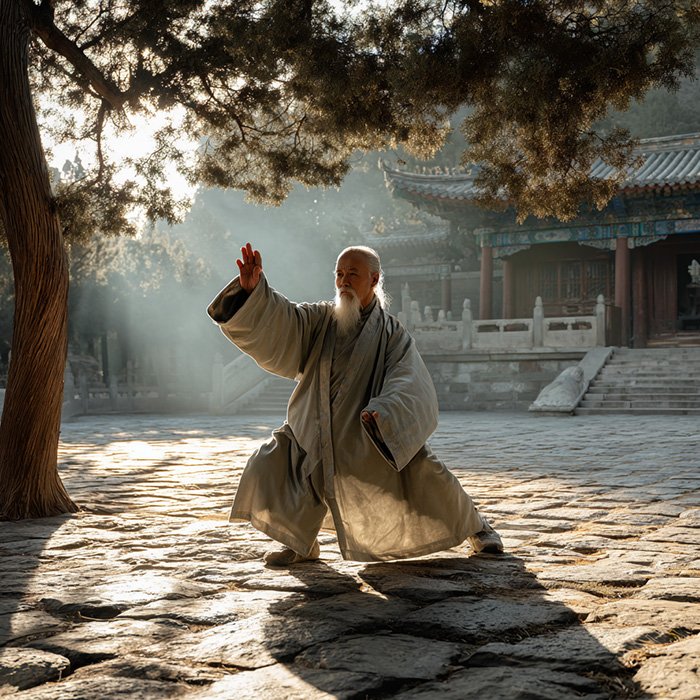
Tai Chi originated in 17th-century China, when Chen Wangting systematized family martial techniques into what’s now known as Chen-style Tai Chi, though legend attributes its creation to the Taoist sage Zhang Sanfeng. You’ll find its philosophical roots in the I Ching’s concept of Taiji and in Daoist neidan teachings on qi cultivation. The practice diversified into five major styles—Chen, Yang, Wu (two distinct lineages), Hao, and Sun—before China’s 1956 standardization made it globally accessible. Today, over 300 million practitioners worldwide embrace it primarily for health benefits rather than combat, and exploring its evolution reveals fascinating cultural transformations.
Ancient Philosophical Roots in Chinese Cosmology
While Tai Chi is often recognized today as a martial art and health practice, its deepest foundations lie in philosophical systems that emerged over three millennia ago in ancient China. The I Ching (Book of Changes), dating to the Zhou Dynasty, first introduced the concept of Taiji (Supreme Ultimate), representing the cosmological source from which Yin and Yang emerge. These complementary opposites—symbolizing dynamic interdependence—became central to Tai Chi’s theoretical framework. Both Taoist and Confucian traditions embraced Taiji cosmology, with Neo-Confucianism later integrating Daoist principles of movement, stillness, and the “Middle Way” (zhong). Early Tai Chi texts explicitly quoted classics including the I Ching, Great Learning, Zhuangzi, and writings by Zhu Xi and Mencius, demonstrating direct philosophical lineage from these ancient sources. The practice also draws on Taoist neidan teachings concerning qi and the three dantian, reflecting its grounding in internal energy cultivation.
The Legendary Zhang Sanfeng and Mythical Beginnings
A mist-shrouded figure stands at the intersection of history and legend in accounts of Tai Chi’s origins: Zhang Sanfeng, the Taoist sage credited with founding the art during China’s tumultuous transition from Yuan to Ming dynasty rule (14th-15th centuries CE). You’ll encounter va us creation narratives—most famously, Zhang’s observation of a snake-crane battle on Wudangshan, where flowing defensive movements inspired Tai Chi’s characteristic softness, overcoming hardness. This mythology positioned Tai Chi as an “internal” martial art emphasizing Qi cultivation and Yin-Yang balance, deliberately contrasting with Shaolin’s “external” force-based methods. However, scholarly consensus views Zhang as either a composite figure or an idealized symbol rather than Tai Chi’s singular historical founder. The attribution gained prominence during the late Ming and Qing periods, serving nationalist narratives that elevated Daoist martial traditions. Historical records suggest Zhang was born in Shanxi Province during the 12th or 13th century, though the exact dates remain subject to scholarly debate.
Chen Wangting: The Historical Founder
Beyond the mythological mists surrounding Zhang Sanfeng, historians identify Chen Wangting (1580–1660) as the verifiable founder who systematized Tai Chi Chuan into a coherent martial art during the late Ming Dynasty. As a retired military general and 9th-generation leader of Chen Village in Henan Province, you’ll find he synthesized existing family fighting techniques around 1670 into what became Chen-style Tai Chi. His innovation integrated Taoist philosophy, Yi Jing principles, Yin-Yang theory, and Traditional Chinese Medicine’s meridian system into a distinctive internal martial art. Chen Wangting created multiple routines—including the 108-posture long fist form and explosive Cannon Fist (Pao Chui)—emphasizing “softness overcoming hardness” through circular, flowing movements punctuated by sudden power. After the fall of the Ming dynasty ruined his opportunities for military advancement, he devoted his retirement years to studying the Huang Ting Classic while developing his martial arts legacy. His teachings remained within the Chen family for generations before being disseminated more broadly in the 19th century.
Evolution Through the Ming and Qing Dynasties
During the tumultuous transition from Ming to Qing rule in the mid-17th century, Tai Chi Chuan underwent a significant transformation from a localized Chen family practice into an increasingly codified martial system. Chen Wangting systematized the art by integrating his military experience with Taoist philosophy—particularly Yin-Yang balance and Wu Xing theory—alongside classical Chinese medical principles. Throughout the Qing dynasty (1644–1912), distinct styles emerged beyond Chen’s foundational form. Yang Luchan’s introduction of Tai Chi to Beijing in the early 19th century proved pivotal, adapting movements into the more accessible Yang style and shifting practice from village secrecy to urban recognition. His teachings attracted the imperial court, bringing unprecedented prestige to the art. This saw the standardization of routines, the incorporation of weapons training (sword, saber, spear), and the formalization of push-hands techniques, all while preserving Taoist internal alchemy traditions emphasizing Qi circulation and health cultivation.
Yang Luchan and the Spread Beyond Chen Village
Though born into poverty in Yongnian County, Hebei Province in 1799, Yang Luchan would fundamentally transform Tai Chi from an insular Chen family practice into China’s most influential internal martial art. After observing a distinctive soft martial art at Chen Dehu’s pharmacy, he pursued training under Chen Changxing in Chenjiagou village. Yang’s dedication earned him acceptance as a disciple, where he mastered the Chen-style “old frame” and adapted it into a more accessible form emphasizing flowing movements and internal power. His adapted style, known as “cotton boxing”, emphasized the principle of overcoming force with softness. Relocating to Beijing, his reputation as “Yang the Invincible” attracted elite students, including Imperial Guards, Prince Duan, and Wu Yuxiang. This marked Tai Chi’s crucial transition from village secret to widespread practice, directly influencing four of the five major Tai Chi lineages through Yang’s students and descendants.
The Emergence of Major Tai Chi Styles
Yang Luchan’s revolutionary spread of Tai Chi catalyzed an unprecedented diversification of styles throughout the late 19th and early 20th centuries. While Chen style remained the foundational form originating with Chen Wangting in the 17th century, you’ll find that new lineages emerged through Yang’s disciples. Wu Quanyou’s son, Wu Jianquan, developed the Wu (Jianquan) style, characterized by compact postures and forward lean. Simultaneously, Wu Yuxiang created his distinct Wu style by synthesizing Chen and Yang principles into small, subtle movements. His student Hao Weizhen later refined this approach into the Hao style, emphasizing precise internal energy control. Most recently, Sun Lutang synthesized Hao’s teachings with Xingyiquan and Baguaquan in the early 20th century, creating Sun style’s distinctive high stances and nimble footwork. The Chen style itself contains two basic empty-hand forms along with specialized techniques, including jumping, punching, and qin na.
Standardization and the Simplified 24-Form
In 1956, the Chinese Sports Committee commissioned five tai chi masters—Chu Guiting, Cai Longyun, Fu Zhongwen, Zhang Yu, and committee leader Li Tianji—to develop a simplified form that would make tai chi accessible to China’s general population for health promotion. The resulting 24-posture form, based primarily on Yang Cheng-Fu’s traditional 108-movement Yang-style sequence, eliminated difficult and repetitive movements while retaining essential tai chi principles, reducing performance time to approximately six minutes. While designed as a self-contained practice, the simplified form also serves as a foundation for students who wish to progress to more advanced training, including the 48-posture form, the 42-posture competition form, traditional long forms, weapons forms, and partner exercises. You’ll find this standardization initiative marked a pivotal shift in tai chi’s evolution, as the government distributed official textbooks and illustrations to ensure uniform teaching across physical education programs, transforming what had been primarily a martial art into a widespread public health practice.
Government Initiative in 1956
Following the establishment of the People’s Republic of China, the government recognized Tai Chi’s potential as a cost-effective public health intervention amid severe resource constraints. In 1956, you’ll find the Ministry of Health and General Administration of Sport initiated a systematic standardization project, convening a committee of Tai Chi masters primarily from the Yang tradition. This collaborative effort aimed to preserve traditional principles while creating accessible forms for mass practice. The committee synthesized the traditional Yang long form’s 108 movements—requiring 20-40 minutes—into the streamlined “Beijing 24” or 24-posture form, executable in 5-7 minutes. You’ll observe this initiative reflected in Mao Zedong’s broader cultural strategy, integrating traditional Chinese practices into state-sponsored health programs, thereby establishing Tai Chi’s dual identity as both cultural heritage and practical fitness resource. The standardization project drew upon Taijiquan’s foundations in Yin & Yang theories to ensure the simplified form maintained the essential balance between opposing energies that characterizes traditional practice.
Simplified Form’s Core Features
The committee’s synthesis produced a 24-posture form that fundamentally transformed Tai Chi’s accessibility while preserving its traditional Yang-style foundation. You’ll find this condensed sequence derived from Yang Chengfu’s 108-movement long form, strategically reduced to eliminate repetitions and technically challenging postures. The resulting six-minute routine exercises both body sides evenly through smooth, circular movements that retain essential Tai Chi principles. Simplified Taijiquan, the official textbook distributed through China’s education system, documented these standardized movements for uniform nationwide practice. This form’s design enabled learners to achieve proficiency within weeks rather than years, making it suitable for all ages and fitness levels. The Chinese government’s 1956 initiative aimed to keep citizens healthy through widespread Tai Chi practice across the nation. The standardization established what became known interchangeably as the “Beijing form,” “24-pattern form,” or “short form,” serving as both a self-contained practice and foundational preparation for advanced sequences.
Global Accessibility and Adoption
Beyond China’s borders, the Simplified 24-Form catalyzed Tai Chi’s transformation into a genuinely global practice throughout the late twentieth and early twenty-first centuries. UNESCO’s 2020 inscription of Tai Chi Chuan on the Intangible Cultural Heritage list legitimized this cultural export, promoting cross-cultural exchange while encouraging standardization of core elements. You’ll find that research publications increased significantly from 2004 to 2023, with the United States, Japan, South Korea, Australia, and Canada contributing substantial scholarship alongside China’s dominant output. The standardized form facilitated uniform teaching protocols across health, fitness, and rehabilitation contexts internationally. Studies demonstrate Tai Chi’s effectiveness in addressing conditions from fibromyalgia to osteoarthritis, with research particularly focused on cognitive function, balance, and chronic disease management. Adoption patterns reveal that middle-aged and older adults, particularly women comprising two-thirds of practitioners, embrace Tai Chi primarily for health benefits, including fall prevention, pain management, and sleep improvement, practiced predominantly in accessible public parks and community spaces.
Global Expansion in the 20th Century
How did an ancient Chinese martial art transform into a global wellness phenomenon embraced by hundreds of millions worldwide? You’ll find the answer in three pivotal developments. First, Chinese immigration and public performances introduced Tai Chi internationally during the early 20th century. Second, the 1956 Beijing 24-form standardization made practice accessible to all demographic groups, thereby fundamentally democratizing what had previously been an elite martial art. Third, the Cultural Revolution’s displacement of masters to Taiwan, Hong Kong, and America accelerated the westward transfer of knowledge. Post-1960s America proved particularly receptive, where Cheng Man-ch’ing established influential teaching centers. By emphasizing health over combat, these immigrant masters attracted Western practitioners seeking Eastern wellness philosophies. Government-sponsored promotion transformed Tai Chi from a martial discipline into a public health intervention, ultimately reaching over 300 million global practitioners by the 21st century.
From Martial Art to Modern Wellness Practice
If you trace Tai Chi’s evolution, you’ll observe a deliberate shift from its 17th-century origins as a Chen family martial system designed for combat effectiveness to a predominantly health-oriented practice by the early 20th century. This transformation accelerated when Yang Luchan (1799-1872) adapted Chen techniques into softer, more accessible forms that emphasized internal energy cultivation over fighting applications, thereby enabling broader public participation (Wile, 1996). You’ll find that subsequent modifications by Yang’s descendants and other masters progressively de-emphasized martial techniques while foregrounding therapeutic benefits such as improved balance, stress reduction, and Qi circulation, fundamentally redefining Tai Chi’s purpose in modern contexts (Koh, 1981).
Combat Origins and Techniques
While popular imagination often attributes Tai Chi’s creation to Zhang Sanfeng, a semi-mythical Taoist monk who allegedly developed the art after observing a combat between a snake and a crane during the 12th to 15th centuries, historical evidence points to a more concrete origin in 17th-century Chen Village, Henan Province. You’ll find that Chen Wangting, a military general, integrated battlefield experience with Taoist principles of yin-yang and Five Elements theory to create a sophisticated combat system. This martial art employed strikes, joint locks, throws, and grappling techniques designed for battlefield effectiveness. Chen style’s explosive movements and low stances demonstrate these combat roots. The core principle—”conquering the unyielding by yielding”—allowed practitioners to redirect opponent energy through circular, spiraling motions rather than direct confrontation, combining offensive and defensive applications within choreographed sequences (taolu).
Health Benefits and Adaptation
Over the course of the 20th century, Tai Chi underwent a fundamental transformation from combat discipline to therapeutic exercise, driven by China’s public health initiatives and mounting scientific evidence of its medical efficacy. You’ll find that modernized forms simplified traditional sequences, applying medical knowledge to maximize therapeutic accessibility. Research has substantiated substantial health benefits: studies demonstrate up to a 50% reduction in fall risk, prompting endorsements from the CDC and the American Geriatrics Society. Clinical trials reveal 35% decreases in osteoarthritis pain and stiffness, while cardiovascular markers improve significantly. Cognitive benefits include enhanced memory and neuroplasticity in older adults, with reductions in anxiety and depression. Integrative medicine now recognizes Tai Chi as an evidence-based complementary therapy, with specialized programs like Tai Chi for Arthritis validating rapid benefits within weeks, positioning it as an adjunct treatment in rehabilitation and chronic disease management.
Conclusion
You’ve now traced tai chi’s evolution from ancient Daoist philosophy through Zhang Sanfeng’s legendary origins to Chen Wangting’s documented seventeenth-century innovations (Henning, 2007). You’ve observed its transformation as Yang Luchan democratized the practice beyond Chen village, leading to five major styles by the twentieth century (Davis, 2004). Finally, you’ve witnessed its global metamorphosis from martial art to wellness phenomenon, particularly following the 1956 Simplified Form’s introduction (Koh, 1981). This journey reveals tai chi’s remarkable adaptive capacity across four centuries.